
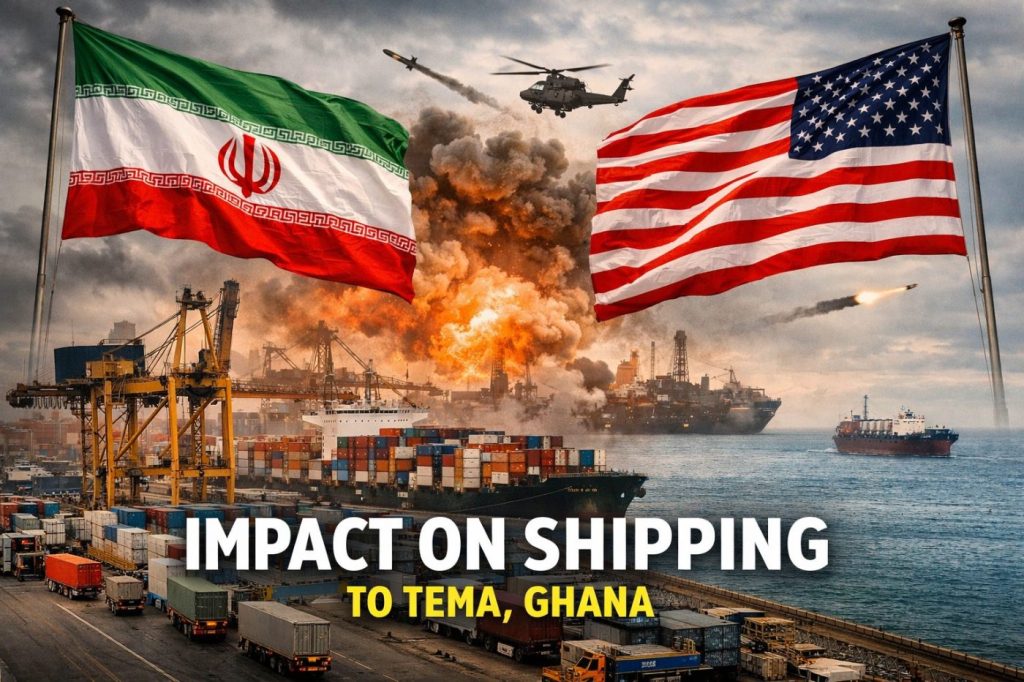
When we hear about tensions between the United States and Iran, it can feel far away from everyday business in Ghana. The conflict is thousands of miles from our shores. But in reality, global trade connects us all. What happens in the Middle East can quietly but powerfully affect containers arriving at Tema Port.
If a USA–Iran war were to break out, the impact on shipping and logistics in Ghana would be real, practical, and immediate.
Let’s break it down in simple terms.
It Starts with the Sea Routes
The Middle East is home to some of the world’s most important shipping corridors, especially the Strait of Hormuz and the route linking the Red Sea to the Suez Canal.
These are not just lines on a map. They are highways for global trade.
If war disrupts those routes:
- Ships may avoid the area completely.
- Carriers may suspend services.
- Vessels may reroute around the Cape of Good Hope.
For importers in Ghana, that could mean your 30-day shipment suddenly becomes a 45–50-day shipment. Delivery timelines stretch. Planning becomes uncertain. Customers start asking questions.
And in logistics, uncertainty is costly.
Freight Rates Would Climb—Fast
Shipping companies like Maersk, MSC, and CMA CGM operate based on risk and cost calculations.
When risk increases, prices follow.
In a war scenario, we would likely see:
- War risk surcharges
- Emergency rate increases
- Reduced vessel frequency
- Equipment shortages
For Ghanaian businesses, this means higher freight charges almost overnight. And because shipping is part of your landed cost, everything from flooring materials to machinery to consumer goods becomes more expensive.
Fuel Prices Would Affect Everyone
The Strait of Hormuz carries a significant portion of the world’s oil. Any disruption there usually triggers global oil price spikes.
For Ghana, this has a double effect:
- Higher bunker fuel costs for ships (which increase freight rates).
- Higher local fuel prices for trucking, inland haulage, and operations.
So even after your container lands in Tema, moving it to Accra, Kumasi, or Tamale could cost more.
In simple terms, a war far away can increase transport costs right here at home.
Insurance Costs Would Rise Quietly
During geopolitical conflicts, marine insurance premiums increase. Cargo insurance becomes more expensive. Some routes may even be considered “high risk.”
This adds another layer of cost to imports.
It may not be as visible as freight rates, but it quietly pushes up the final price of goods.
Pressure on African Ports
If global vessels avoid risky regions, shipping patterns change.
More vessels may move along the West African coast. Transshipment hubs may become busier. Container imbalances can happen.
While Tema Port is modern and efficient, sudden global rerouting can still create:
- Longer waiting times
- Equipment shortages
- Terminal congestion
- Delays in vessel schedules
Even a few days of delay can disrupt supply chains, especially for businesses working with tight inventory cycles.
What This Really Means for Ghanaian Businesses
For importers, exporters, freight forwarders, and manufacturers, the real impact is operational:
- Harder rate negotiations
- Increased landed costs
- Unpredictable transit times
- Strained cash flow due to higher upfront expenses
For project cargo and large shipments, budgeting becomes more complicated. For fast-moving consumer goods, pricing strategies must adjust quickly.
In short, stability supports trade. Uncertainty slows it down.
The Bigger Picture
Ghana may not be directly involved in a USA–Iran conflict, but we are deeply connected to global trade. In today’s world, shipping lanes are the arteries of commerce. When they tighten, everyone feels the pressure.
A war in the Middle East would not just be a headline on international news. It would show up in freight invoices, fuel receipts, insurance documents, and delivery timelines at Tema.
Final Thoughts
Global events remind us how interconnected logistics truly is. For Ghanaian businesses, preparation is key:
- Build flexibility into contracts
- Maintain strong relationships with carriers
- Consider buffer inventory where possible
- Monitor global developments closely
In logistics, foresight is power.
Because sometimes, what happens thousands of miles away can determine when your container docks at Tema.


